A great English estate garden is never one garden. It is a sequence of them, unfolding across the year in the same few acres. The border that looks like a low green hump in March is a wall of scarlet and gold by August; the lawn that seems merely lawn in June is a sheet of crocus in February. Knowing roughly what blooms when turns a pleasant wander into something closer to a conversation with the place — and it saves you from arriving a fortnight too late for the roses.
What follows is a seasonal map of the English garden year, with the plants and estate gardens that show each moment at its best. Timings shift with latitude and weather, so treat the months as bands rather than dates.
Late Winter: Scent, Bark and the First Nods (January–February)
This is the season for gardeners rather than tourists, and the rewards are quiet but real. Snowdrops come first, carpeting woodland floors and damp lawns; the great displays at Anglesey Abbey in Cambridgeshire and Colesbourne Park in Gloucestershire draw crowds for good reason. Look for winter aconites, small golden cups that open only in sunshine, and hellebores, whose downward-facing flowers are best admired by lifting a bloom gently with one finger.
Winter is also when scent carries furthest. Witch hazel, winter honeysuckle, Viburnum × bodnantense and sweet box are almost always planted beside paths for exactly this reason — slow down when you reach them. Bare trees show their other qualities too: the polished mahogany of Tibetan cherry, the coloured stems of dogwood, and the clipped bones of yew and box that hold a garden together when everything else has gone.
Early Spring: Daffodils, Blossom and the Walled Garden Wakes (March–April)
March belongs to daffodils and narcissi, naturalised in grass under old trees. Because the foliage needs weeks of growth after flowering to recharge the bulb, the finest drifts tend to be in places where mowing is deliberately delayed — parkland, orchards and the slopes below a house. Magnolias and camellias follow on sheltered walls, then cherry blossom, brief and worth planning around.
By mid-April the walled garden is a different world from the park outside. Brick and stone hold warmth, so fruit blossom, wall-trained peaches and early tulips run days or weeks ahead of the open ground. Late April brings bluebells to the woods — a native spectacle at Blickling, Sheffield Park and Wakehurst — and the first tulips in earnest.
May and Early June: The Crescendo
If you visit an English estate garden only once, make it now. Wisteria pours over old brick, laburnum tunnels come into flower, alliums stand like purple drumsticks through the borders, and bearded irises open in the drier, sunnier beds. Peonies follow, heavy-headed and short-lived, then the first roses.
This is also the moment when garden design becomes legible: the long axes, the gaps in hedges, the borrowed view across a lake. Structure that was invisible in February is suddenly framed by growth.
Midsummer: Roses and the Herbaceous Border (June–July)
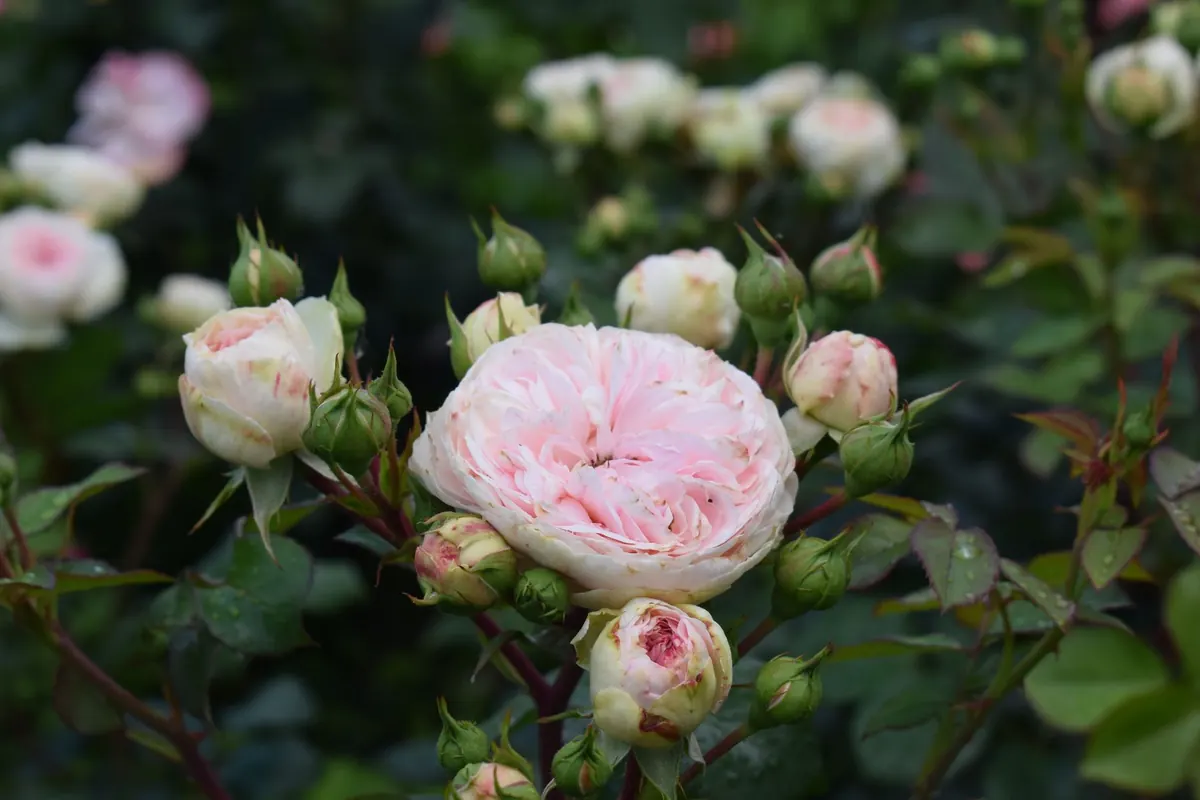
Roses define high summer. Old roses peak in the first half of June — the collection at Mottisfont in Hampshire is one of the finest anywhere — while repeat-flowering varieties carry on into autumn. Sissinghurst's rose garden and the intimate compartments at Hidcote are at their most persuasive in this window, when the scent is strongest in the early morning and again at dusk.
Behind them, the herbaceous border builds. Delphiniums, lupins, campanulas and geraniums give way to the great set pieces of July: the hot borders at Great Dixter, the Lutyens and Jekyll terraces at Hestercombe, lavender hedges alive with bees. If you want to see these borders at their peak, look for gardens that stake early and deadhead relentlessly — those are the ones worth the drive.
High Summer and Early Autumn: The Underrated Weeks (August–September)
Many visitors assume the garden is finished by August. It is not. Dahlias, crocosmias, heleniums, phlox, echinaceas and ornamental grasses give the late border a density and colour that June cannot match, and salvias and penstemons keep going until the first frost.
Two things to seek out:
- Gravel and dry gardens, where thymes, thistles and Verbena thrive in heat and look best in strong light.
- Long-grass meadows cut late in the season, now a feature of several estate parks and a haven for insects.
Autumn: Berries, Colchicums and Turning Trees (October–November)
October is subtle rather than showy. Colchicums rise leafless from lawns, nerines glow against warm walls, and cyclamen settle under trees. Berries take over from flowers: rowan, cotoneaster, holly and the hips and haws in hedgerows. Japanese anemones will still be flowering when the first real gales arrive.
Then the trees turn. Sheffield Park in East Sussex, Winkworth Arboretum in Surrey and the wooded slopes at Stourhead in Wiltshire are the classic places to see colour reflected in water. Go on a still, bright morning before the leaves fall.
Winter: Structure, Bark and Scent Again (December–February)
By December the garden is reduced to its architecture — avenues, hedges, terraces, stone — and this is precisely when that architecture is easiest to read. Several estates have made a virtue of it with dedicated winter gardens, planted for bark, scent and evergreen form; Anglesey Abbey, Dunham Massey and Beningbrough are good examples. Look for winter-flowering iris against a warm wall, Christmas roses, and the coloured stems of dogwood cut back each spring to keep them vivid.
One practical warning: many historic gardens close or reduce their hours between November and February. Check before travelling.
Timing Your Visit
A little planning makes the difference between a good day out and a memorable one.
- Check the garden's own updates. Most estates publish a weekly or fortnightly note on what is looking good — more reliable than any general calendar.
- Allow for regional lag. Gardens in Cornwall and along the south coast run two to three weeks ahead of those in Northumberland, Yorkshire or the Peak District. A daffodil walk in early April may be perfect in one county and over in another.
- Arrive early. Light is better, scent is stronger, and the paths are quiet.
- Book two visits a season apart. Succession is the whole point of a well-made garden; seeing the same borders twice teaches you more than a single trip ever will.
- Ask at the gate. Volunteers and gardeners usually know exactly which corner is worth walking to that week, and they are rarely wrong.
Accept that you will always miss something. That is not a failure of planning but the nature of a garden designed to be visited more than once — and the best reason to come back.
Photo: Iryna Ilieva / Pexels